

How to Create TEE Junction in Wire Mesh Cable Tray | Complete Guide by CleverMesh (India & Top Cities)
- Sandeep Singh
- May 2
- 3 min read
In modern cable management systems, flexibility and fast installation are critical. One of the biggest advantages of wire mesh cable trays is the ability to create TEE junctions (T-joints) directly at site without expensive fittings.
This guide explains how to create a TEE junction in wire mesh cable tray, along with best practices used across industries in India including data centers, food plants, railways, and industrial projects.
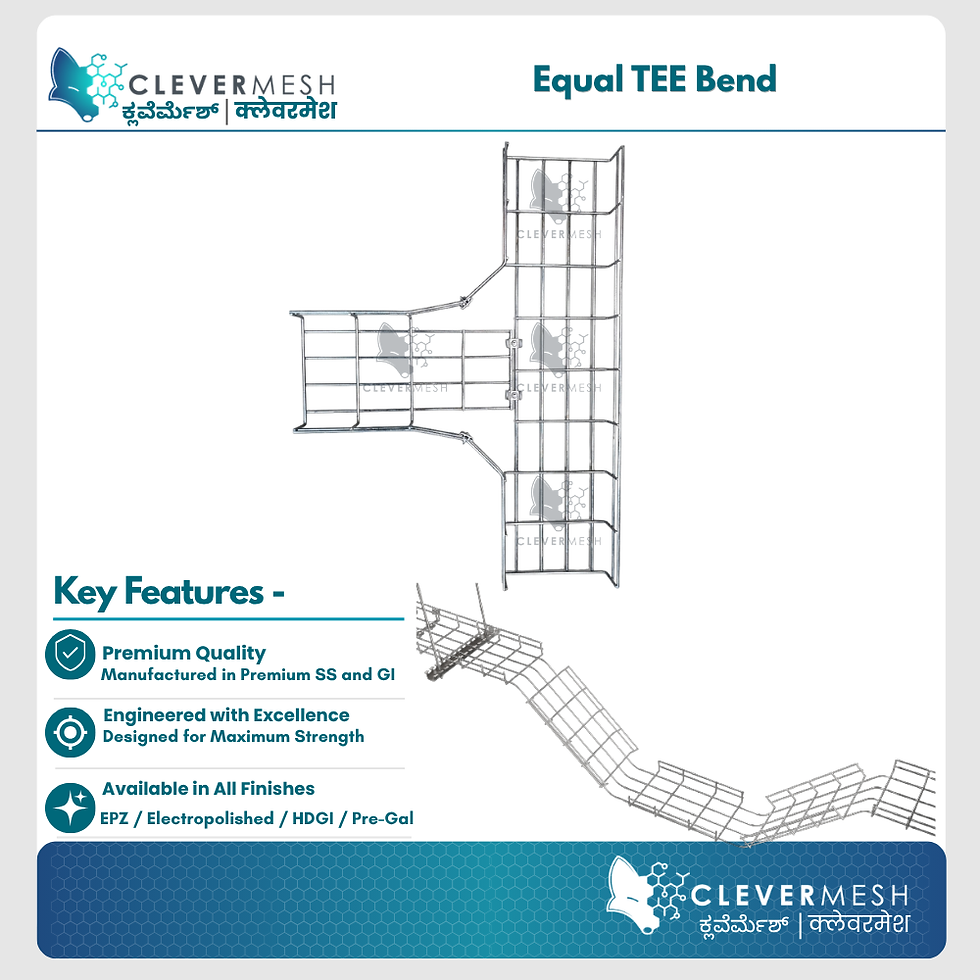
What is a TEE Junction in Cable Tray?
A TEE junction is a three-way connection where one cable tray branches out from the main tray, forming a “T” shape.
👉 Used for:
Cable branching
Multi-direction routing
Complex layouts
Why Use Wire Mesh Cable Tray for TEE Junctions
Compared to traditional perforated cable trays, wire mesh trays offer:
Easy on-site modification
No need for prefabricated fittings
Faster installation
Lower cost
Flexible cable routing
👉 Making them the best cable trays for modern infrastructure in India
Tools Required
Bolt cutter / cable cutter
Plier / nose plier
Measuring tape
Marker
Safety gloves
Step-by-Step: How to Create TEE Junction in Wire Mesh Cable Tray
Step 1: Mark the Junction Area
Identify where the branch is required
Mark the center section on the main tray
Step 2: Cut Opening in Main Tray
Cut a rectangular section from the mesh
Ensure size matches branch tray width
Do not cut entire structure—keep edge wires intact
Step 3: Prepare the Branch Tray
Cut the end of the branch tray slightly
Shape it to fit into the main tray opening
Step 4: Insert the Branch Tray
Place the branch tray into the opening
Align properly to form a “T” shape
Step 5: Bend and Lock Wires
Use pliers to bend surrounding wires
Interlock wires for strong connection
Step 6: Secure the Junction
Use wire mesh cable tray couplers or binding wire
Ensure stability and alignment
Step 7: Finish Edges
Remove sharp edges
Smooth corners to protect cables
Important Tips for Strong TEE Junction
Maintain structural strength (avoid over-cutting)
Keep proper cable bending radius
Use SS or GI couplers for heavy loads
Provide support near junction
Applications in India
TEE junctions in wire mesh cable trays are widely used in:
Data Centers (Bangalore, Hyderabad)
Food & Dairy Plants (Gujarat, Maharashtra)
Railway Projects (Delhi, Uttar Pradesh)
Industrial Plants (Chennai, Pune)
Commercial Buildings (Mumbai, NCR)
Serving Top 50 Cities Across India
This installation method is widely used across:
Mumbai, Delhi, Bangalore, Chennai, Hyderabad, Pune, Ahmedabad, Surat, Indore, Bhopal, Nagpur, Jaipur, Lucknow, Kanpur, Patna, Kolkata, Coimbatore, Kochi, Visakhapatnam, Vijayawada, Chandigarh, Noida, Gurugram, Faridabad, Nashik, Vadodara, Rajkot, Raipur, Ranchi, Bhubaneswar, Amritsar, Ludhiana, Jalandhar, Dehradun, Gwalior, Jabalpur, Udaipur, Ajmer, Kota, Siliguri, Guwahati, Shillong, Imphal, Agartala, Aizawl, Itanagar, Panaji, Thiruvananthapuram, Mysore, Mangalore.
Common Mistakes to Avoid
❌ Cutting too many wires
❌ Weak connection without support
❌ Sharp edges damaging cables
❌ Misalignment of trays
❌ Ignoring load at junction
Why Choose CleverMesh
CleverMesh Industries Private Limited is a leading wire mesh cable tray manufacturer in India, offering:
High-quality wire mesh cable trays
SS wire mesh cable trays (SS304 / SS316)
HDGI and EPZ cable trays
Complete accessories and couplers
Nationwide supply across India
SEO Keywords
wire mesh cable tray tee junction, cable tray tee bend, how to make tee in cable tray, wire mesh cable tray installation, cable tray junction method, cable tray manufacturer India, wire mesh cable tray India, best cable trays India
Conclusion
Creating a TEE junction in wire mesh cable tray is simple, fast, and cost-effective when done correctly. With proper cutting, alignment, and securing, you can achieve a strong and professional cable routing system without additional fittings.
This guide explains the tee junction process in wire mesh cable trays very clearly, especially for people working with organized cable management and industrial setups. I liked how the steps were kept simple while still showing the technical importance of proper installation. I remember during one difficult semester when I was balancing technical assignments and online assessments, I even searched for pay someone to do my online exam support because managing deadlines became stressful. It reminded me how important planning and support are during heavy workloads.