

Cable Tray Load Calculation Guide: How to Select the Right Wire Mesh Cable Tray | CleverMesh
In any electrical project, selecting the correct wire mesh cable tray is not just about size—it’s about load capacity, safety, and long-term performance. Improper load calculation can lead to tray bending, cable damage, or even system failure.
At CleverMesh, we help engineers and consultants choose the right cable tray system with accurate load calculations and optimized designs.

What is Cable Tray Load Capacity?
Cable tray load capacity refers to the maximum weight a cable tray can safely carry per meter, including:
Weight of all cables
Future cable additions
Safety factor
It is usually expressed in kg/m (kilograms per meter).
Why Load Calculation is Important
Accurate cable tray load calculation ensures:
✅ No sagging or deformation
✅ Long service life
✅ Safe cable management
✅ Compliance with industrial standards
Step-by-Step Cable Tray Load Calculation
Step 1: Calculate Cable Weight
Identify:
Cable type (power, control, data)
Diameter and weight per meter
👉 Example:
Cable Type | Qty | Weight (kg/m) | Total (kg/m) |
Power Cable | 10 | 2.5 | 25 |
Control Cable | 20 | 0.5 | 10 |
Data Cable | 30 | 0.2 | 6 |
Total Cable Load = 41 kg/m
Step 2: Add Future Load (Important)
Always consider 25–30% extra capacity for future expansion.
👉 Example:41 × 1.25 = 51.25 kg/m
Step 3: Apply Safety Factor
Industry standard safety factor: 1.5
👉 Final Load:51.25 × 1.5 = ~77 kg/m
Step 4: Select Tray Based on Span
Load capacity depends heavily on support span distance.
Typical spans:
1.2 meter
1.5 meter
2.0 meter
👉 Longer span = lower load capacity
Step 5: Choose Right Wire Mesh Cable Tray
At CleverMesh, we recommend:
Selecting tray width based on cable volume
Checking load charts (available on request)
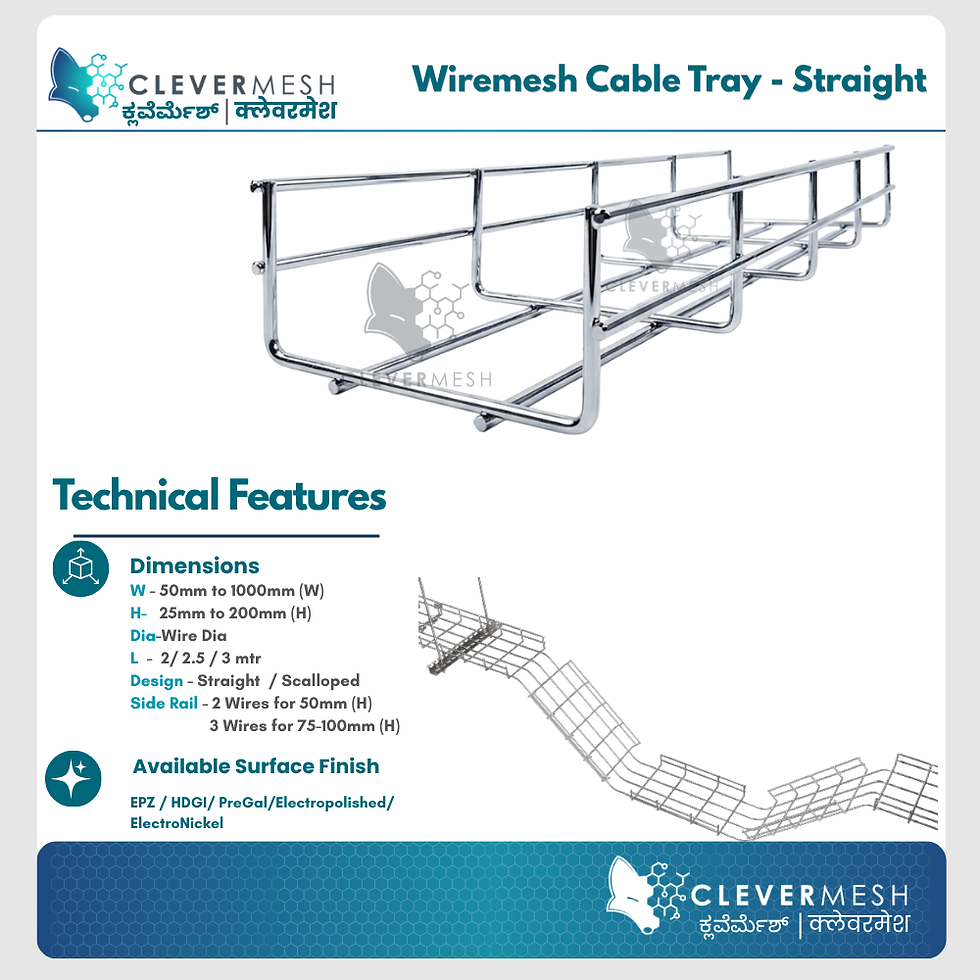
Choosing proper wire thickness (4mm, 5mm, 6mm etc.)
Important Factors Affecting Load Capacity
1. Wire Diameter
Higher diameter = higher strength
2. Mesh Size
Smaller mesh = better load distribution
3. Material
GI (Pre-Galvanized) → Indoor use
HDGI → Outdoor & corrosion resistance
SS304 / SS316 → Harsh environments
Common Mistakes to Avoid
❌ Ignoring future cable load
❌ Using long spans without support
❌ Selecting tray only by width
❌ Not considering environment (corrosion, temperature)
Why Choose CleverMesh for Cable Tray Design?
Expert guidance for load calculation & selection
High-strength wire mesh cable trays
Custom solutions for industrial & export projects
Available in GI, HDGI, SS304, SS316
Trusted wire mesh cable tray manufacturer in India
Applications
CleverMesh trays are widely used in:
Data Centers
Industrial Plants
Infrastructure Projects
Commercial Buildings
Power & Electrical Systems
Conclusion
Correct cable tray load calculation is critical for safe and efficient cable management. By considering cable weight, future expansion, span, and safety factors, you can ensure long-term performance.
With CleverMesh, you get not just products—but complete engineering support for optimized cable tray systems.
Comments